
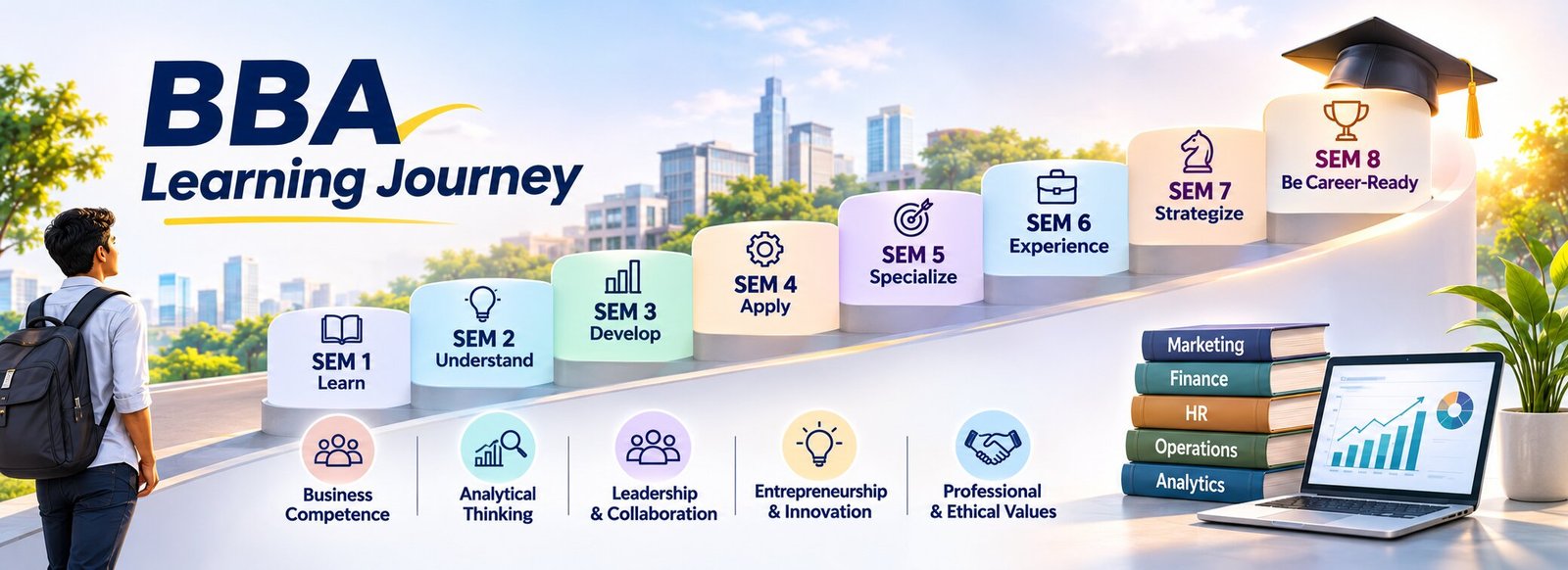
BBA Semester Learning Journey
| Semester | Learning Type | Focus | What the Student Will Be Doing | Skills Developed | Key Outputs | Industry / Real-World Exposure | Progression |
|---|---|---|---|---|---|---|---|
| SEM 1 | Theory + Practical | Business Foundation | Understand business basics, management concepts, economics, accounting and business communication. | Communication, numerical ability, basic business understanding, teamwork | Assignments, presentations, basic business exercises | Business cases and organizational examples | Understand business |
| SEM 2 | Theory + Practical | Core Business Knowledge | Learn how different business functions work and apply concepts through practical exercises and cases. | Analytical thinking, business communication, financial awareness, problem-solving | Case studies, reports, presentations | Real business scenarios | Build core capability |
| SEM 3 | Theory + Practical | Functional Skills | Develop knowledge in areas such as marketing, finance, HR, operations and business analytics. | Functional business skills, data interpretation, decision-making, collaboration | Functional projects, case analyses | Industry practices and business cases | Develop business skills |
| SEM 4 | Theory + Practical | Business Application | Solve business problems through projects, simulations, market studies and practical assignments. | Problem-solving, market analysis, presentation, project management | Mini-projects, business reports, presentations | Market/industry projects | Apply knowledge |
| SEM 5 | Theory + Practical | Specialization | Explore advanced and specialized areas such as Marketing, Finance, HR, Entrepreneurship, Operations or Business Analytics. | Specialized functional skills, strategic thinking, professional tools | Specialized projects, business plans | Industry-oriented assignments | Choose a career direction |
| SEM 6 | Internship / Project / Research | Industry & Professional Exposure | Work on an internship, live business project, research project or industry problem and document the learning. | Professional communication, research, project management, workplace skills | Internship report, live project, presentation | Direct industry exposure | Experience business |
| SEM 7 | Advanced Theory + Practical | Strategic Management | Study advanced management concepts, leadership, strategy, innovation, analytics and contemporary business issues. | Leadership, strategic thinking, business analytics, decision-making | Strategic projects, consulting-style cases | Complex business problems | Think strategically |
| SEM 8 | AEDP / Capstone | Professional Readiness | Complete an independent capstone/AEDP, startup/business plan, consulting project or industry assignment. | Leadership, entrepreneurship, project management, negotiation, presentation | Capstone project, business plan, final presentation | Industry / entrepreneurship / consulting | Become career-ready |
BBA Skill Progression
| Semester | Stage | Skill Progression |
|---|---|---|
| SEM 1 | Learn | → Business fundamentals |
| SEM 2 | Understand | → Core business functions |
| SEM 3 | Develop | → Functional skills |
| SEM 4 | Apply | → Solve business problems |
| SEM 5 | Specialize | → Choose a career direction |
| SEM 6 | Experience | → Work with industry |
| SEM 7 | Strategize | → Develop leadership and strategic thinking |
| SEM 8 | Demonstrate | → Become professionally ready |
BBA Graduate Attributes
| No. | Graduate Attribute | Brief Explanation |
|---|---|---|
| 01 | Business & Management Competence | Demonstrates a strong understanding of business functions, management principles and organizational practices. |
| 02 | Analytical & Decision-Making Ability | Uses data, business information and logical reasoning to evaluate situations and make informed decisions. |
| 03 | Leadership & Collaboration | Leads and works effectively with diverse teams while demonstrating interpersonal and organizational skills. |
| 04 | Entrepreneurial & Innovative Mindset | Identifies opportunities, develops innovative solutions and demonstrates an entrepreneurial approach to business challenges. |
| 05 | Professional & Ethical Responsibility | Demonstrates professionalism, ethical conduct, adaptability and awareness of the wider social and economic impact of business decisions. |
BBA Program Outcomes
| No. | Program Outcome | Brief Explanation |
|---|---|---|
| PO1 | Business Knowledge | Apply concepts and principles of management, marketing, finance, HR, operations, economics and other business functions. |
| PO2 | Business Problem Solving | Analyze business situations and develop practical, evidence-based solutions to organizational problems. |
| PO3 | Data & Digital Skills | Use appropriate business tools, digital technologies and data-analysis techniques to support business decisions. |
| PO4 | Leadership & Entrepreneurship | Demonstrate leadership, teamwork, entrepreneurial thinking and the ability to initiate and manage business projects. |
| PO5 | Professional Readiness | Communicate effectively, demonstrate ethical and professional behavior, and apply business knowledge in industry, entrepreneurship, higher education or other professional contexts. |
BBA in Automobile Management
Specialisation Options
- Electric Vehicle Business
- Automotive Retail & Dealership Management
Unique Value Proposition
Combines automotive business management with emerging electric mobility to prepare graduates for the transformation of the global automotive marketplace.
Industry / Sector Relevance
The automotive sector is evolving through electrification, changing consumer expectations, and digital retail models. This programme supports vehicle manufacturers, dealership networks, mobility companies, EV businesses, automotive finance providers, after-sales organisations, and distribution networks adapting to the future of mobility.
Employability Prospects
Graduates develop capabilities in automotive marketing, dealership operations, customer relationship management, EV business models, sales management, and business operations. Their specialised industry knowledge supports careers in dealership management, automotive sales, business development, customer experience, and mobility services.
Academic Differentiators
Unlike general business programmes, the curriculum contextualises management principles within the automotive sector. Industry-focused case studies, dealership operations, mobility trends, and electric vehicle business models provide students with practical commercial understanding of a rapidly changing industry.
Course Focus Area
Students study automotive business, dealership management, vehicle retailing, EV markets, customer relationship management, automotive finance, marketing, supply networks, business strategy, and operational management. The programme develops commercial leadership capabilities specific to the automotive industry.
Future Readiness
Graduates are prepared to lead businesses adapting to electric mobility, digital automotive retailing, connected customer experiences, and evolving transportation markets.
BBA in Construction Management
Specialisation Options
- Real Estate Management
- Infrastructure Project Management
Unique Value Proposition
Combines construction business management with infrastructure project delivery to prepare graduates for leadership across the built environment sector.
Industry / Sector Relevance
Large-scale infrastructure investment and urban development continue to drive demand for construction management professionals. This programme supports construction firms, infrastructure developers, project management consultancies, real estate companies, engineering organisations, and public sector agencies managing complex development projects.
Employability Prospects
Graduates develop knowledge of construction operations, project coordination, contract administration, real estate management, budgeting, and infrastructure delivery. Their industry-specific management skills support careers in project management, construction operations, property development, consultancy, and infrastructure administration.
Academic Differentiators
The curriculum combines business management with construction and infrastructure contexts, providing greater industry relevance than a conventional BBA. Applied case studies, project planning exercises, and commercial decision-making strengthen students’ understanding of construction business environments.
Course Focus Area
Students study construction business, project management, infrastructure development, real estate operations, contracts, procurement, risk management, finance, leadership, and organisational management. The programme develops commercial and managerial competencies for construction-related enterprises.
Future Readiness
Graduates are prepared for careers supporting sustainable infrastructure, modern project delivery, urban development, and increasingly digital construction businesses.
BBA in Digital Marketing & E Commerce
Specialisation Options
- Performance Marketing
- Digital Commerce Operations
Unique Value Proposition
Integrates data-driven marketing with measurable digital growth strategies to prepare graduates for the evolving digital economy.
Industry / Sector Relevance
Businesses increasingly rely on digital channels to acquire customers, build brands, and drive growth. This programme supports marketing agencies, consumer brands, technology companies, e-commerce businesses, media organisations, start-ups, and consulting firms seeking professionals skilled in digital marketing and marketing analytics.
Employability Prospects
Graduates develop expertise in digital campaigns, customer acquisition, search marketing, social media, marketing analytics, and campaign optimisation. Their ability to combine creativity with analytical decision-making supports careers in digital marketing, brand management, media planning, growth marketing, and marketing consultancy.
Academic Differentiators
The curriculum combines strategic marketing with performance measurement, ensuring students understand not only how to create campaigns but also how to evaluate their effectiveness. Practical projects, campaign simulations, and analytical tools provide industry-relevant commercial experience.
Course Focus Area
Students study digital marketing strategy, consumer behaviour, performance marketing, marketing analytics, content marketing, search marketing, social media, customer engagement, campaign management, and marketing technologies. The programme develops strategic, analytical, and communication capabilities.
Future Readiness
Graduates are prepared to lead marketing initiatives in increasingly digital, data-driven, and customer-centric business environments.
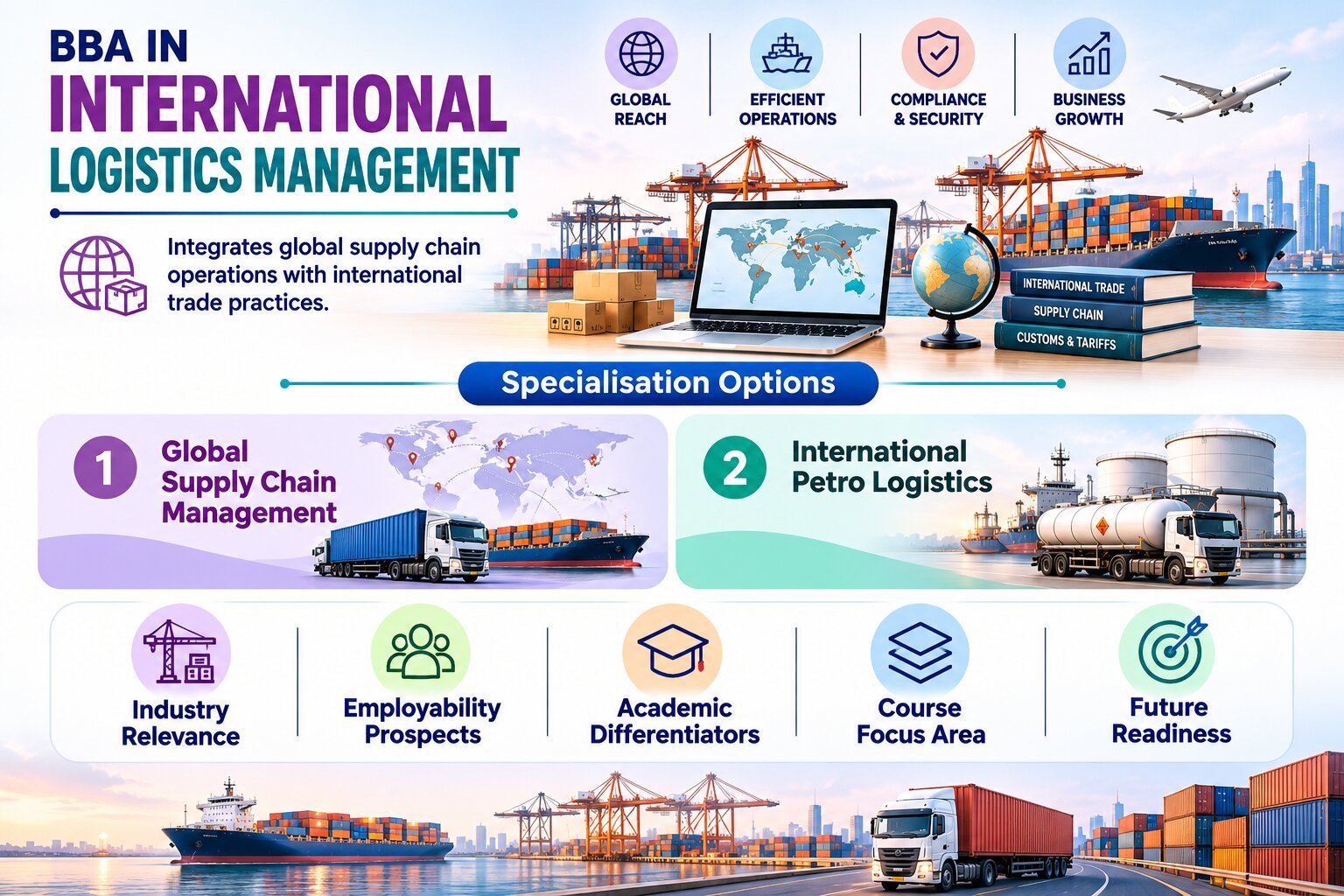
BBA in International Logistics Management
Specialisation Options
- Global Supply Chain Management
- International Petro Logistics
Unique Value Proposition
Integrates global supply chain operations with international trade practices to prepare graduates for managing cross-border commerce and logistics networks.
Industry / Sector Relevance
International trade depends on efficient logistics, customs compliance, and coordinated global supply chains. This programme supports shipping companies, freight forwarders, ports, logistics providers, exporters, importers, multinational corporations, customs consultancies, and international trade organisations operating across global markets.
Employability Prospects
Graduates develop expertise in international logistics, customs procedures, trade documentation, supply chain coordination, and global distribution. Their specialised knowledge supports careers in freight management, international procurement, export-import operations, logistics consulting, trade compliance, and supply chain planning.
Academic Differentiators
The curriculum combines logistics management with international trade regulations, providing a broader commercial perspective than conventional logistics programmes. Case studies, trade simulations, and applied business exercises help students understand the operational and regulatory complexities of global commerce.
Course Focus Area
Students study global supply chains, international trade, customs procedures, freight forwarding, shipping operations, trade documentation, procurement, inventory management, logistics strategy, and international business practices. The programme develops managerial competencies for global logistics enterprises.
Future Readiness
Graduates are prepared to manage increasingly interconnected supply chains, digital trade ecosystems, and international logistics operations supporting global business growth.
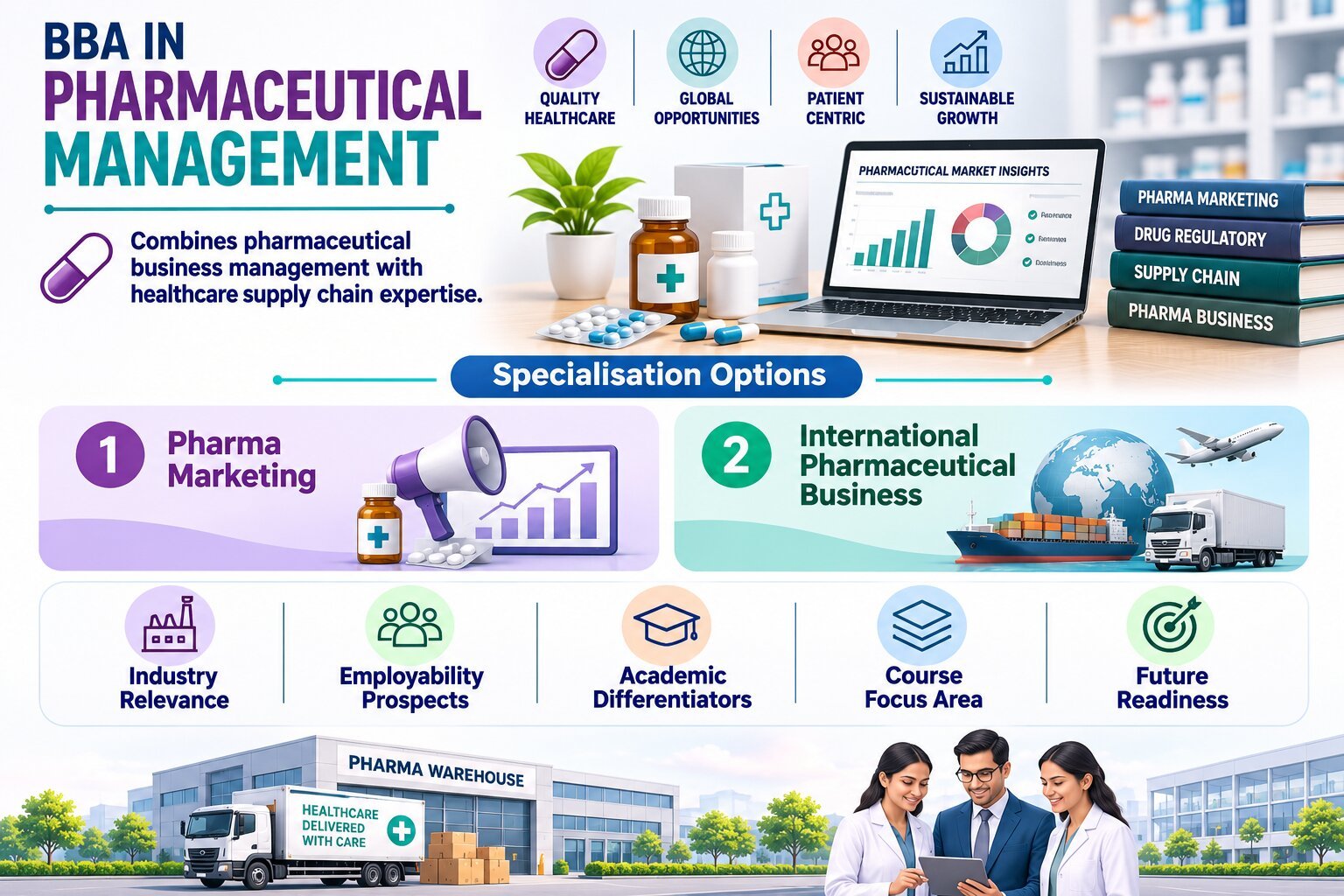
BBA in Pharmaceutical Management
Specialisation Options
- Pharma Marketing
- International Pharmaceutical Business
Unique Value Proposition
Combines pharmaceutical business management with healthcare supply chain expertise to prepare graduates for the highly regulated life sciences industry.
Industry / Sector Relevance
The pharmaceutical sector requires professionals who understand both commercial operations and healthcare distribution. This programme is relevant to pharmaceutical companies, medical distributors, hospitals, healthcare organisations, biotechnology firms, contract manufacturers, and healthcare consulting organisations operating in regulated markets.
Employability Prospects
Graduates develop expertise in pharmaceutical marketing, healthcare supply chains, product management, regulatory awareness, customer engagement, and commercial operations. Their industry-specific knowledge supports careers in pharmaceutical sales, product management, healthcare logistics, business development, and healthcare administration.
Academic Differentiators
The curriculum applies management principles specifically to pharmaceutical and healthcare businesses, combining commercial strategy with healthcare distribution. Industry case studies, regulatory contexts, and healthcare business applications provide practical insight into this specialised sector.
Course Focus Area
Students study pharmaceutical marketing, healthcare supply chains, product management, regulatory frameworks, customer relationship management, operations, distribution, healthcare business strategy, finance, and organisational management. The programme develops commercial capabilities tailored to healthcare industries.
Future Readiness
Graduates are equipped for careers supporting expanding pharmaceutical markets, healthcare innovation, resilient medical supply chains, and evolving healthcare business ecosystems.
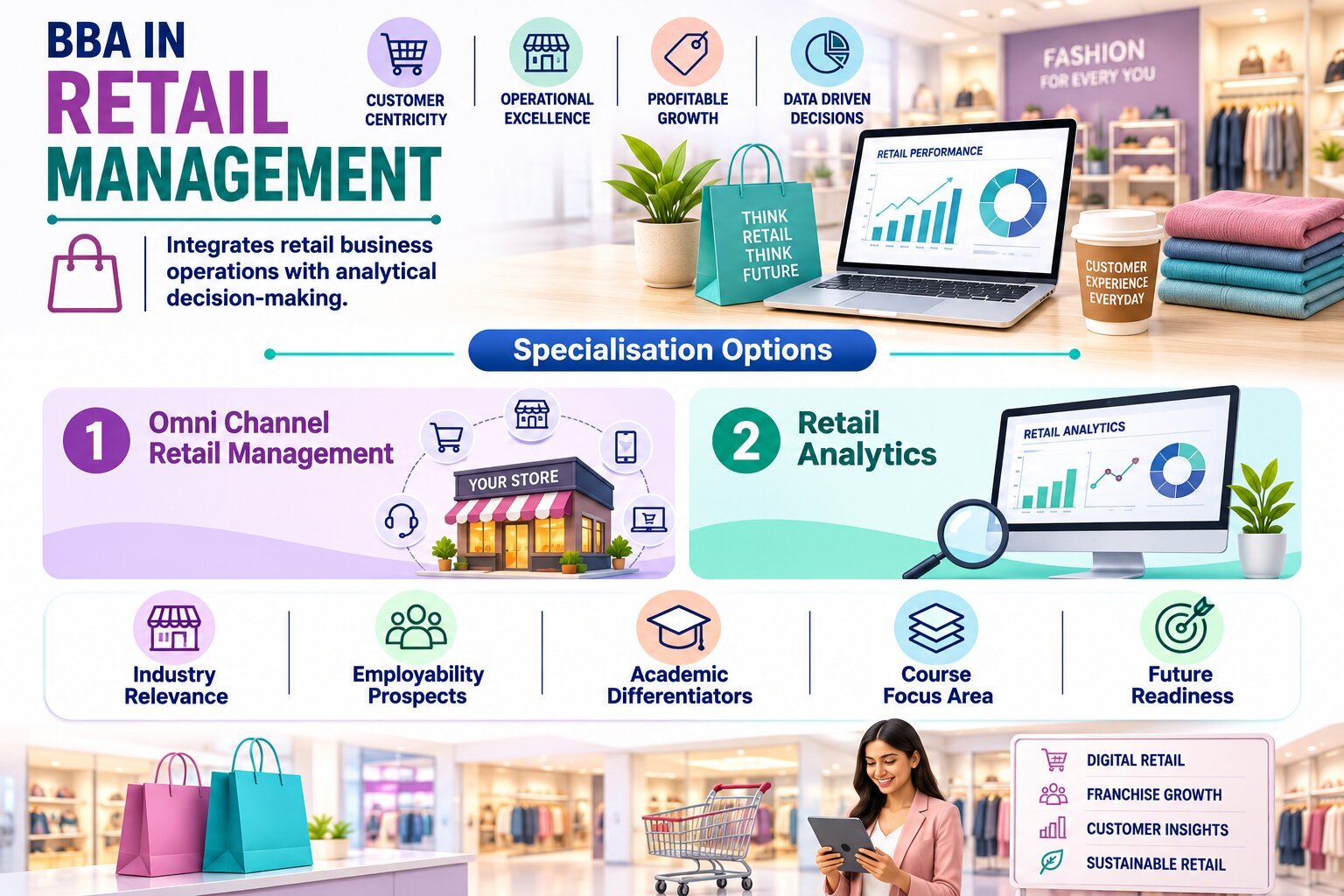
BBA in Retail Management
Specialisation Options
- Omni Channel Retail Management
- Retail Analytics
Unique Value Proposition
Integrates retail business operations with analytical decision-making to prepare graduates for managing modern retail networks and franchise ecosystems.
Industry / Sector Relevance
Retail organisations increasingly rely on franchise expansion, customer insights, and operational efficiency to remain competitive. This programme supports retail chains, franchise businesses, consumer brands, supermarkets, shopping centres, lifestyle retailers, and distribution companies operating across organised retail markets.
Employability Prospects
Graduates develop expertise in retail operations, franchise management, customer engagement, merchandising, retail analytics, and business development. Their specialised capabilities support careers in retail management, franchise operations, category management, business analytics, store management, and retail consulting.
Academic Differentiators
The curriculum combines franchise management with retail analytics, offering a distinctive perspective beyond traditional retail business education. Applied retail projects, consumer analysis, and operational case studies strengthen commercial decision-making and management capability.
Course Focus Area
Students study retail operations, franchise management, merchandising, customer behaviour, retail analytics, sales management, inventory planning, business strategy, marketing, and retail performance management. The programme develops commercial and managerial competencies for organised retail businesses.
Future Readiness
Graduates are prepared for leadership roles in digitally enabled retail, franchise expansion, customer-centric businesses, and data-driven retail management.
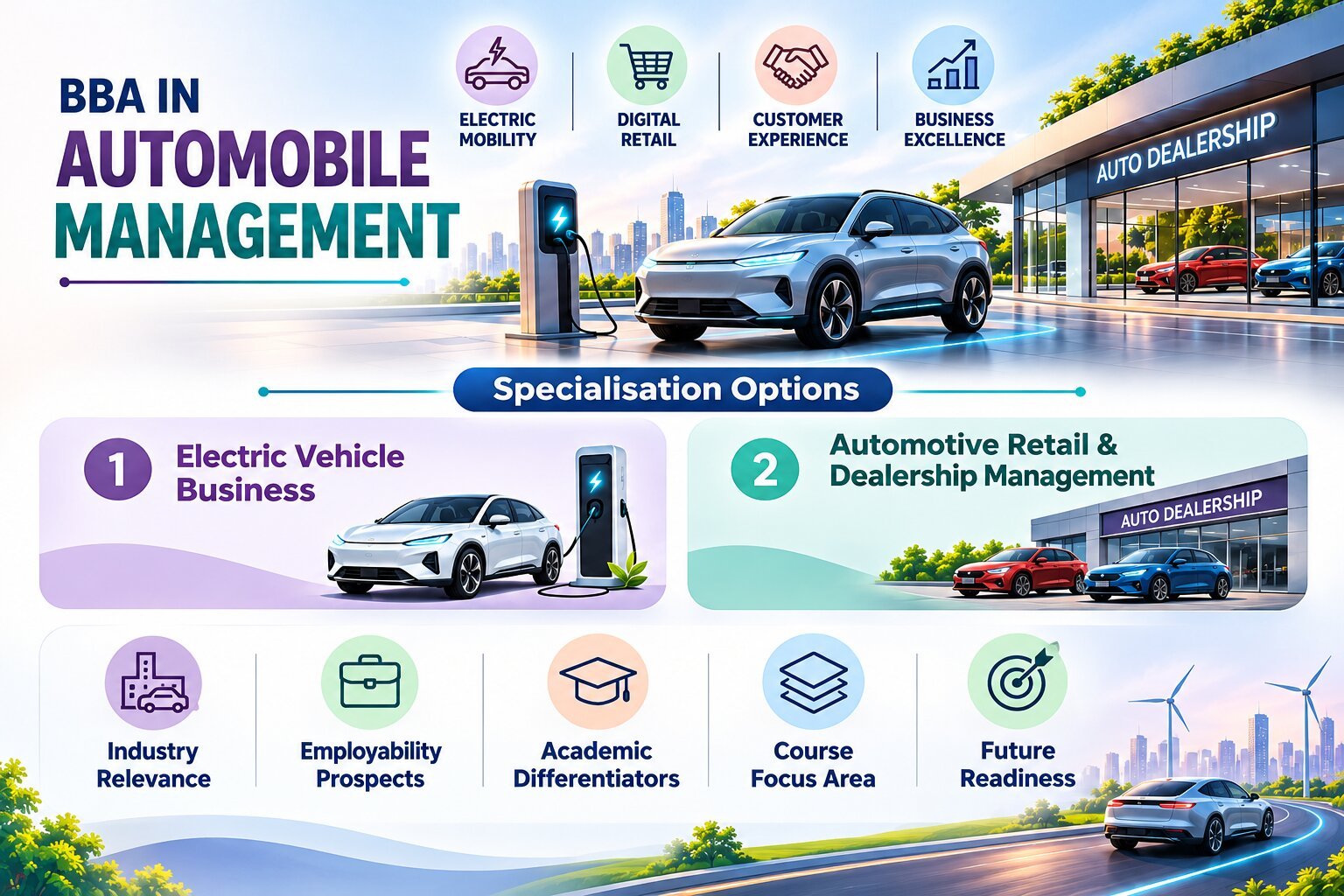
BBA in Automobile Management
Specialisation Options
- Electric Vehicle Business
- Automotive Retail & Dealership Management
Unique Value Proposition
Combines automotive business management with emerging electric mobility to prepare graduates for the transformation of the global automotive marketplace.
Industry / Sector Relevance
The automotive sector is evolving through electrification, changing consumer expectations, and digital retail models. This programme supports vehicle manufacturers, dealership networks, mobility companies, EV businesses, automotive finance providers, after-sales organisations, and distribution networks adapting to the future of mobility.
Employability Prospects
Graduates develop capabilities in automotive marketing, dealership operations, customer relationship management, EV business models, sales management, and business operations. Their specialised industry knowledge supports careers in dealership management, automotive sales, business development, customer experience, and mobility services.
Academic Differentiators
Unlike general business programmes, the curriculum contextualises management principles within the automotive sector. Industry-focused case studies, dealership operations, mobility trends, and electric vehicle business models provide students with practical commercial understanding of a rapidly changing industry.
Course Focus Area
Students study automotive business, dealership management, vehicle retailing, EV markets, customer relationship management, automotive finance, marketing, supply networks, business strategy, and operational management. The programme develops commercial leadership capabilities specific to the automotive industry.
Future Readiness
Graduates are prepared to lead businesses adapting to electric mobility, digital automotive retailing, connected customer experiences, and evolving transportation markets.
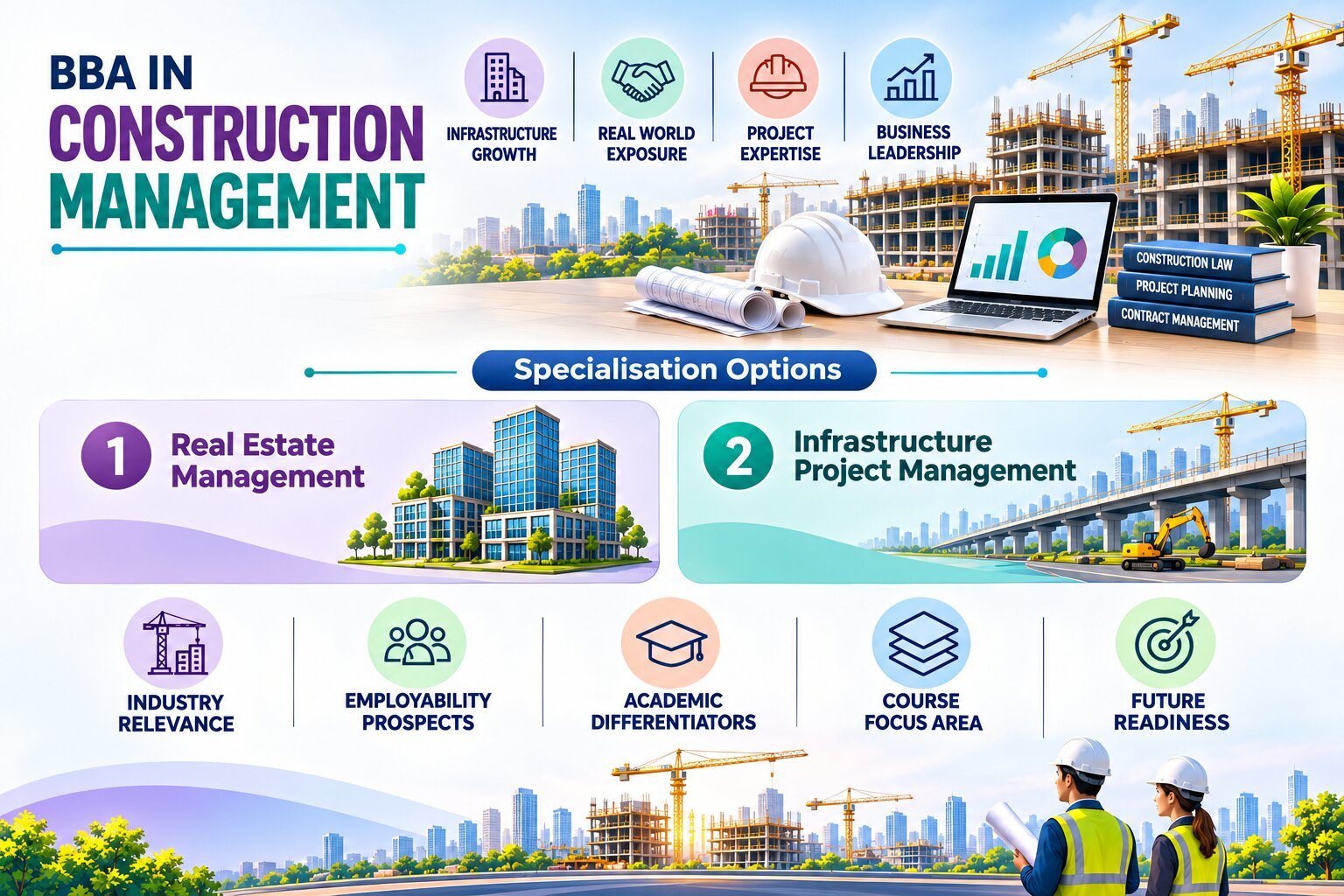
BBA in Construction Management
Specialisation Options
- Real Estate Management
- Infrastructure Project Management
Unique Value Proposition
Combines construction business management with infrastructure project delivery to prepare graduates for leadership across the built environment sector.
Industry / Sector Relevance
Large-scale infrastructure investment and urban development continue to drive demand for construction management professionals. This programme supports construction firms, infrastructure developers, project management consultancies, real estate companies, engineering organisations, and public sector agencies managing complex development projects.
Employability Prospects
Graduates develop knowledge of construction operations, project coordination, contract administration, real estate management, budgeting, and infrastructure delivery. Their industry-specific management skills support careers in project management, construction operations, property development, consultancy, and infrastructure administration.
Academic Differentiators
The curriculum combines business management with construction and infrastructure contexts, providing greater industry relevance than a conventional BBA. Applied case studies, project planning exercises, and commercial decision-making strengthen students’ understanding of construction business environments.
Course Focus Area
Students study construction business, project management, infrastructure development, real estate operations, contracts, procurement, risk management, finance, leadership, and organisational management. The programme develops commercial and managerial competencies for construction-related enterprises.
Future Readiness
Graduates are prepared for careers supporting sustainable infrastructure, modern project delivery, urban development, and increasingly digital construction businesses.
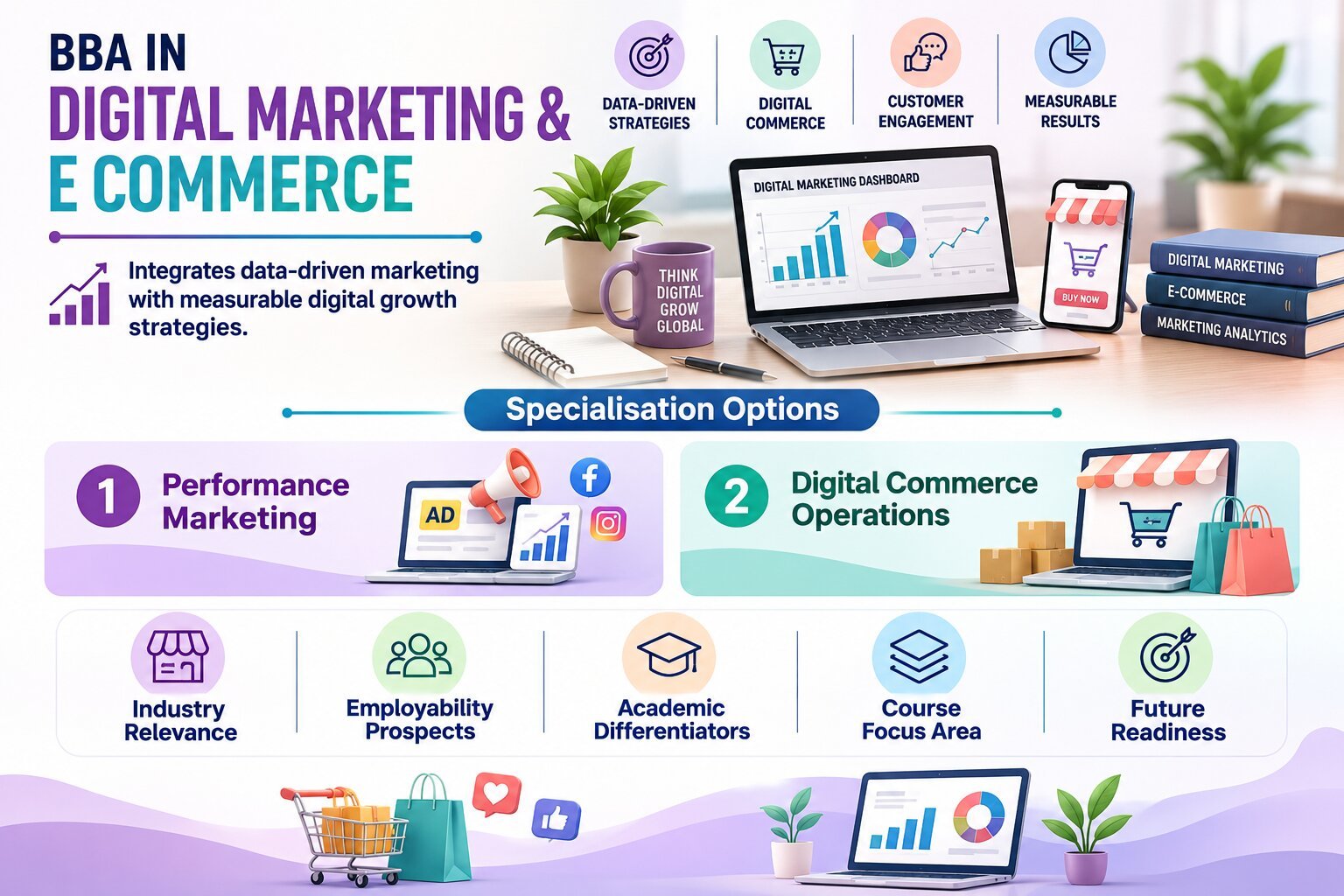
BBA in Digital Marketing & E Commerce
Specialisation Options
- Performance Marketing
- Digital Commerce Operations
Unique Value Proposition
Integrates data-driven marketing with measurable digital growth strategies to prepare graduates for the evolving digital economy.
Industry / Sector Relevance
Businesses increasingly rely on digital channels to acquire customers, build brands, and drive growth. This programme supports marketing agencies, consumer brands, technology companies, e-commerce businesses, media organisations, start-ups, and consulting firms seeking professionals skilled in digital marketing and marketing analytics.
Employability Prospects
Graduates develop expertise in digital campaigns, customer acquisition, search marketing, social media, marketing analytics, and campaign optimisation. Their ability to combine creativity with analytical decision-making supports careers in digital marketing, brand management, media planning, growth marketing, and marketing consultancy.
Academic Differentiators
The curriculum combines strategic marketing with performance measurement, ensuring students understand not only how to create campaigns but also how to evaluate their effectiveness. Practical projects, campaign simulations, and analytical tools provide industry-relevant commercial experience.
Course Focus Area
Students study digital marketing strategy, consumer behaviour, performance marketing, marketing analytics, content marketing, search marketing, social media, customer engagement, campaign management, and marketing technologies. The programme develops strategic, analytical, and communication capabilities.
Future Readiness
Graduates are prepared to lead marketing initiatives in increasingly digital, data-driven, and customer-centric business environments.
BBA in International Logistics Management
Specialisation Options
- Global Supply Chain Management
- International Petro Logistics
Unique Value Proposition
Integrates global supply chain operations with international trade practices to prepare graduates for managing cross-border commerce and logistics networks.
Industry / Sector Relevance
International trade depends on efficient logistics, customs compliance, and coordinated global supply chains. This programme supports shipping companies, freight forwarders, ports, logistics providers, exporters, importers, multinational corporations, customs consultancies, and international trade organisations operating across global markets.
Employability Prospects
Graduates develop expertise in international logistics, customs procedures, trade documentation, supply chain coordination, and global distribution. Their specialised knowledge supports careers in freight management, international procurement, export-import operations, logistics consulting, trade compliance, and supply chain planning.
Academic Differentiators
The curriculum combines logistics management with international trade regulations, providing a broader commercial perspective than conventional logistics programmes. Case studies, trade simulations, and applied business exercises help students understand the operational and regulatory complexities of global commerce.
Course Focus Area
Students study global supply chains, international trade, customs procedures, freight forwarding, shipping operations, trade documentation, procurement, inventory management, logistics strategy, and international business practices. The programme develops managerial competencies for global logistics enterprises.
Future Readiness
Graduates are prepared to manage increasingly interconnected supply chains, digital trade ecosystems, and international logistics operations supporting global business growth.
BBA in Pharmaceutical Management
Specialisation Options
- Pharma Marketing
- International Pharmaceutical Business
Unique Value Proposition
Combines pharmaceutical business management with healthcare supply chain expertise to prepare graduates for the highly regulated life sciences industry.
Industry / Sector Relevance
The pharmaceutical sector requires professionals who understand both commercial operations and healthcare distribution. This programme is relevant to pharmaceutical companies, medical distributors, hospitals, healthcare organisations, biotechnology firms, contract manufacturers, and healthcare consulting organisations operating in regulated markets.
Employability Prospects
Graduates develop expertise in pharmaceutical marketing, healthcare supply chains, product management, regulatory awareness, customer engagement, and commercial operations. Their industry-specific knowledge supports careers in pharmaceutical sales, product management, healthcare logistics, business development, and healthcare administration.
Academic Differentiators
The curriculum applies management principles specifically to pharmaceutical and healthcare businesses, combining commercial strategy with healthcare distribution. Industry case studies, regulatory contexts, and healthcare business applications provide practical insight into this specialised sector.
Course Focus Area
Students study pharmaceutical marketing, healthcare supply chains, product management, regulatory frameworks, customer relationship management, operations, distribution, healthcare business strategy, finance, and organisational management. The programme develops commercial capabilities tailored to healthcare industries.
Future Readiness
Graduates are equipped for careers supporting expanding pharmaceutical markets, healthcare innovation, resilient medical supply chains, and evolving healthcare business ecosystems.
BBA in Retail Management
Specialisation Options
- Omni Channel Retail Management
- Retail Analytics
Unique Value Proposition
Integrates retail business operations with analytical decision-making to prepare graduates for managing modern retail networks and franchise ecosystems.
Industry / Sector Relevance
Retail organisations increasingly rely on franchise expansion, customer insights, and operational efficiency to remain competitive. This programme supports retail chains, franchise businesses, consumer brands, supermarkets, shopping centres, lifestyle retailers, and distribution companies operating across organised retail markets.
Employability Prospects
Graduates develop expertise in retail operations, franchise management, customer engagement, merchandising, retail analytics, and business development. Their specialised capabilities support careers in retail management, franchise operations, category management, business analytics, store management, and retail consulting.
Academic Differentiators
The curriculum combines franchise management with retail analytics, offering a distinctive perspective beyond traditional retail business education. Applied retail projects, consumer analysis, and operational case studies strengthen commercial decision-making and management capability.
Course Focus Area
Students study retail operations, franchise management, merchandising, customer behaviour, retail analytics, sales management, inventory planning, business strategy, marketing, and retail performance management. The programme develops commercial and managerial competencies for organised retail businesses.
Future Readiness
Graduates are prepared for leadership roles in digitally enabled retail, franchise expansion, customer-centric businesses, and data-driven retail management.
Shape Your Business Future
Build practical business skills, develop leadership capabilities, and prepare for a successful professional journey.